Thursday, September 20, 2012

Studio Tours 2012


Susan Keale
invites you to see
her latest
mixed media paintings
&
handmade illustrated books

@ El Dorado County Artists Studio Tour

September 29th & 30th
and
October 6th & 7th

10:00am – 5:00pm

Location #9:
4251 Yellowbrick Rd,
Shingle Springs, CA

Thursday, September 13, 2012

Fall Workshops with Susan Keale


"Autumn Harvest" Illustrated Watercolor Journaling – Intro Level
Saturdays, Oct 20 and 27, 10:00 – 2:00
$100 held at Pence Gallery, Davis, CA
Illustrated Watercolor Journaling is great for travel, home, recipes, and more!  It's like journaling but with drawings and watercolors.  Focusing on the theme of "Autumn Harvest," students will learn to use ink pens and basic drawing, watercolor techniques of color mixing and textures, lettering and page layout, along with fun writing exercises to create lively illustrated journals.  The students will learn how to pack a portable set of art supplies that they can travel with to Halloween adventures, Thanksgiving travels, or simply to their kitchen table.  This is a beginning level course that can be taken more than once because each time there's something new.


"The Holidays!" Illustrated Watercolor Journaling – Intro Level
Saturday Nov. 3, 10:00-3:00 and Sunday Nov 4, 12:30 -  3:30
$100 held at University Art on Marconi in Sacramento, CA
Illustrated Watercolor Journaling is great for travel, home, recipes, and more!  It's like journaling but with drawings and watercolors.  Focusing on the theme of the holiday season, students will learn to use ink pens and basic drawing, watercolor techniques of color mixing and textures, lettering and page layout, along with fun writing exercises to create lively illustrated journals.  The students will learn how to pack a portable set of art supplies that they can travel with to capture winter's magic, on family vacations, or create personalized holiday gifts.  This is a beginning level course that can be taken more than once because each time there's something new.


Hand Made Illustrated Story Books for a Sweet Holiday Recipe
Sacramento Fine Arts Center, Carmichael, CA
November 10, 10am-2pm:   $50
Following in the storybook illustrator's tradition of Beatrix Potter and Tasha Tudor we will draw from a still life, paint our drawing, and write in the recipe.  From the illustrated recipe we will make a fold out book.  No experience necessary.  You will learn illustrating and watercolor techniques, how to decorate the book-cover with texture, and how to bind your book together.  This is a great activity for all and makes great gifts for family and friends.


~No art experience necessary.
~Contact Susan for supply list – materials not included.

530.228.8775       sbk317@yahoo.com

Thursday, September 6, 2012

Artist Archetype

The last several months I have been questioning and writing about what it is to be a bodhisattva artist.  But recently I have been wondering more simply what is it to be an artist?  Is it something a person is born to be?  And, in this world of consumerism, is it possible to be authentic and what is an authentic artist?

Jung identified certain personalities and behaviors that he classified in psychology as archetypes.  The Artist is one of them; Jung specifically categorized it as the Artist-Scientist archetype.   Some of the attributes associated with the Artist-Scientist are their ability to come up with novel solutions, being curious, idealistic, self-confident yet afraid of failing, and having childlike wonder with a logical mind.

A more contemporary view of archetypes comes from the Enneagram type system.  The Artist in this system is characterized as being sensitive, expressive, and spiritual.  Emotions are the vehicle by which the Artist understands themselves, others, and the world.  They do not fear painful emotions and this is often a way for them to develop compassion for the suffering of others and the world.  Nostalgic and idealistic by nature, the Artist seeks meaning, growth, and healing.

I relate very strongly to both descriptions I find of the archetypical Artist.  The listed attributes are characteristics I have had all my life.  Which leads me to believe I was born an artist.  I'm not sure what the karmic implications are to this other than I have the sensibilities that seem ideal for self awareness, thirst for beauty and graceful solutions, and a deep wish to heal my own suffering and be of benefit to others. 

As far as being authentic, I believe that lies in living one's personal truth.  Which in my case, is always changing and expanding, while strangely stays the same.  I think my quarry about authenticity must be an example of being afraid of failure.

Perhaps this is the search for meaning in a world that is inherently empty of meaning.  So Zen . . . there is nothing to attain, no one to be, no place to go.  Just accepting the masterpiece that we are at each given moment.   Curious. . . Art historically, have we moved to a new place that is no longer the iconoclasm of abstract expressionism?  Or the inertia of endless individual expression? What is the focus of art now?

What do you think?  Please share your thoughts in facebook comments or in the comment box below.

Best,
Susan

Thursday, August 30, 2012

I took Maryjo Koch's Botanical Illustration Workshop in Bonny Doon, CA.

 
Maryjo demonstrating painting a thistle.

 Me painting.

 
Beginning my thistle with a graphite watercolor pencil.

 
Adding gouache.

 
My finished thistle.

 
Final project was painting a stick covered in lichen.

Thursday, August 23, 2012

Evolving Art

I have recently been reading a group of inspiring books that I've chosen as a means to awaken or recharge a new level of creativity.  As part of my art practice, at my mentor Andie Thrames' suggestion, I have found it is necessary to review my mission as an artist every six months or so.   This is not only for my own awareness and growth, but so that I can communicate about my art and process in art statements and in sharing creative enthusiasm with others.  To keep myself engaged and charged I have to participate in my education by reading, attending workshops with artists that I want to emulate, and by interacting with art to discover what speaks to me. 

There are four books I'm loving right now in which each author is talking about our interconnectedness.  David Abrams, ecologist and philosopher, speaks magically in Spell of the Sensuous about the history of our disconnect from nature and our inner nature due to the refinement of language and written communication.  Through Abrams mystical descriptions of feeling nature and the ways indigenous cultures view themselves in nature (which is express it via storytelling), one is reintroduced to a once common communion with nature.  This book has philosophical depth that I can sometimes only digest a paragraph at a time.  It is rewiring my mind's concepts about perception.

Meditation is been part of my way of becoming more perceptive and aware my interconnection and inter-dependence with nature.  The nature of our minds is nature.  We are nature.  This isn't new to Buddhism.  The Harmony of Emptiness and Dependent-Arising: Tsong Khapa by Ven. Lobsang Gyatso elaborates on cause and effect in relation to emptiness.  Once again I am reminded of the fault of ignorance and how ignorance of the ultimate nature of phenomena leads to every choice we make.

As I continue absorb the teaching-words in these books I find that something is slipping or softening in how I perceive phenomena.  I listen for the ways nature talks to me and I look for the eyes that are seeing and perceiving me.  I wonder how it is that we humans think we are bigger than and dominant over nature.  Poet Gary Snyder writes so captivatingly in The Practice of the Wild on the wild that we are.  In Snyder's introduction he writes, "A key term is practice:  meaning a deliberate sustained and conscious effort to be more finely tuned to ourselves and to the way the actual existing world is.  'The World,' with the exception of a tiny bit of human intervention, is ultimately a wild place." (p. viii)

It is in this wild place that we live and create.  I have recently been introduced (by Sue West) to the art work of Enrique Martinez Celaya.  A well established and visionary California artist who paints, writes, lectures, educates and inspires others to delve deep and reconnect.  His work is profoundly spiritual from a scientific and globally philosophical view.  In Collected Writings & Interviews, 1990-2010, Enrique Martinez Celaya, taken from Celaya's manifesto, he writes, "It seems more sad than ironic that in the process of mastering our destiny through technology and global reach, we have lost our respect for nature and our sense of belonging to something larger than ourselves."  Celaya sees the artist role to be that of a prophet.  It is with that inspiring idea that I explore and contemplate his work and the works of others engaged in nurturing our awakened minds.

The image above is from my series of painting on California butterflies.  There are over 120 species of butterflies that live in the Sierras according to Dr. Art Shapiro, professor of Evolution and Ecology, and his UC Davis research team.  They have a fantastic website http://butterfly.ucdavis.edu/ with images of each butterfly.  The butterfly represents for me the ability to transform.  My mixed media pieces evolve in an intuitive process of cooperating with the art materials, the subject matter, patterns, and contemplative mind frame.

May you be well and inspired!
Susan


Thursday, August 16, 2012

Art of Illusion

Recently I have been contemplating the illusory nature of the phenomenal world and what is authentic artistic expression? My mind goes blank when I think on these things. I've been wondering how to depict that in my art – with imagery that is authentic to my experience. I can easily be inspired by or borrow ideas from Kandinsky, Duchamp, or O'Keeffe; but how does one find their own original visual voice in the midst of so many creators today? Chogyam Trungpa says in Dharma Art that it requires a lot of meditating.

The idea that meditation is somehow separate from art seems like a mind-emptying, Zen question in itself. Many artists find that art is liberation. Ad Reinhardt is noted in asserting in Smile of the Buddha: Eastern Philosophy and Western Art, that "art was not a practice leading to enlightenment; art is enlightenment." This is indeed an esoteric approach to being a "fine artist," which Reinhardt defines as having "a fine mind, 'free of all passion, ill-will, and delusion.'" (Smile, p. 131)

Reinhardt's description of an artist's mind correlates with the last verse of The Eight Verses of Mind Training. The long version (Rigpa translation) states:

I will learn to keep all these practices

Untainted by thoughts of the eight worldly concerns.

May I recognize all things as like illusions,

And, without attachment, gain freedom from bondage.

HH Dalai Lama divides this verse into two sections (Transforming the Mind, pp 128-132). The first two lines relate to the Eight Worldly Concerns that effect our attitudes. HHDL describes them as "becoming elated when someone praises you, becoming depressed when someone insults or belittles you, feeling happy when you experience success, being depressed when you experience failure, being joyful when you acquire wealth, feeling dispirited when you become poor, being pleased when you have fame, and feeling depressed when you lack recognition." A practitioner (artist) cultivating altruism is warned about these "concerns" muddying our minds. If we agree with Reinhardt's depiction of a "fine artist" then contemplation on the hopes and fears revealed in the Eight Worldly Concerns would certainly assist in refining one's "passion, ill-will, and delusion."

Yet, the teaching that form is emptiness and emptiness is form is also apparent in Verse 8. The last two lines speak specifically of the illusory nature of reality, our phenomenal world. If we take Reinhardt's statement that "art is enlightenment" and situate the nouns thusly art=form and enlightenment=emptiness the teaching on form and emptiness is restated as "art is enlightenment and enlightenment is art." Since Reinhardt was a master at reinterpreting Buddhist teachings into art terms, it is possible that he found a truth in the subtle connection of words to pronounce "art is enlightenment." It would appear that art, then, would be the depicted form of the phenomenal world as it is, which in itself is empty.

The questions I started this note with are still intriguing. I am interested to see how it will influence my paintings. I have a few sketches I'm working on, playing with the flow if ideas that come up.

The illustration that I created a few years ago for Verse 8 is of a peacock. The peacock is a unique bird that can eat poisonous snakes without being harmed. I see Verse 8 as transformation from suffering to liberation; as it is with the peacock that transforms poison into nutrition. This is the altruistic mission of art.

Thank you for journeying through the Eight Verses of Mind Training with me. May these musing be of benefit in creating compassion and wisdom.

Until next week and a new series . . .

Be well,

Susan
Thursday, August 9, 2012

Painting Compassion

This summer my friend, Sue Hammond West, suggested I read Smile of the Buddha: Eastern Philosophy and Western Art from Monet to Today written by Jacquelynn Baas. I love Baas' perspective on art history. She shows how Buddhist philosophy was introduced to European art culture and the influence it had on how and what artists perceived and painted.

Since today's blog is on Verse 7 of the Eight Verses of Mind Training, I am excited to dovetail one of the artists from Smile of the Buddha into my musings: Vincent van Gogh! Most of what I remember of van Gogh is his beautiful paintings and his tortured spirit. I knew he had a strong Evangelical background, but I didn't know the extent of Japanese Buddhism's influence on his and other 19th century European artists. Baas writes, "Art was more effective than religion in conveying his deeply felt compassion for humankind." Van Gogh was a sensitive, generous, reflective, deeply caring man who wanted to alleviate suffering. Buddhism was very inspiring to his work. He "had come to see the ideal artist's life as that of a kind of bodhisattva, dwelling austerely and serenely . . . and devoting himself to the expression of compassion through the creation of works of art that evoke the connections between all levels of existence." (p31-32 Smile)

As I read this essay on van Gogh I kept thinking of Verse 7. Geshe Langri Thangpa's core version states, "Give help and happiness to others, and take on their harm and suffering." In his paintings, van Gogh was giving his supreme joy of feeling spiritually inspired and interconnected . . . Moving brush stokes and color reveals a world that is alive and magical. Van Gogh's paintings visually give a teaching on the Buddhist philosophy.

While Baas and other art historians have documented the Buddhist texts, philosophers, and art forms that van Gogh was aware of I can't help wondering what direction his life would have taken had he had the support of a lineage teacher and a sangha. It is apparent that van Gogh longed for monastic life and tried to create such in Arles with Gauguin. However, without a lineage master and supportive community to study and practice with, it is obvious that van Gogh fell into deep confusion and loneliness. His angst may have included confusion about martyrdom, perhaps leading to his unhappy choice of suicide; which is not what is meant by the Buddhist philosophy of "taking on the suffering of others."

According to HH Dalai Lama in Transforming the Mind, Verse 7 specifically relates to the practice of tonglen - the practice of giving and receiving. Briefly this involves the deep understanding that we all wish to be happy; that we are all one / interconnected; that it is an act of egolessness to "exchange myself for another." It is an attitude we integrate so as to loosen the hold of the ego.

The tonglen practice can be applied to working with our own suffering, that of another's suffering, and the suffering of the world. In the art class I'm teaching on grieving we did a "giving and receiving loving kindness" exercise. First we drew a body scan of the suffering we felt. Then we drew an image of ourselves onto which we drew all the compassion and kindness we wished ourselves to have. The change in the students was palpable. The room's energy went from sadness to lightness with the experience of transforming the mind through compassion.

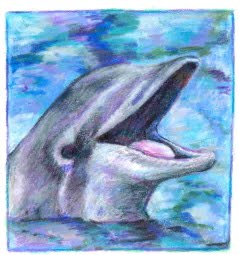
The image I've drawn for this verse is of a laughing dolphin (illustrated with gouache and color pencil). Dolphins have an amazing ability to heal. Much has been written on the gentleness of dolphins and how their keen sensitivity and awareness can transform our perceptions regarding human relations with nature. They are bodhisattva's of the sea.

May we all be well and inspired to act with compassion.

Susan